OttoMatic Engine
In development
Faster from script to screen.
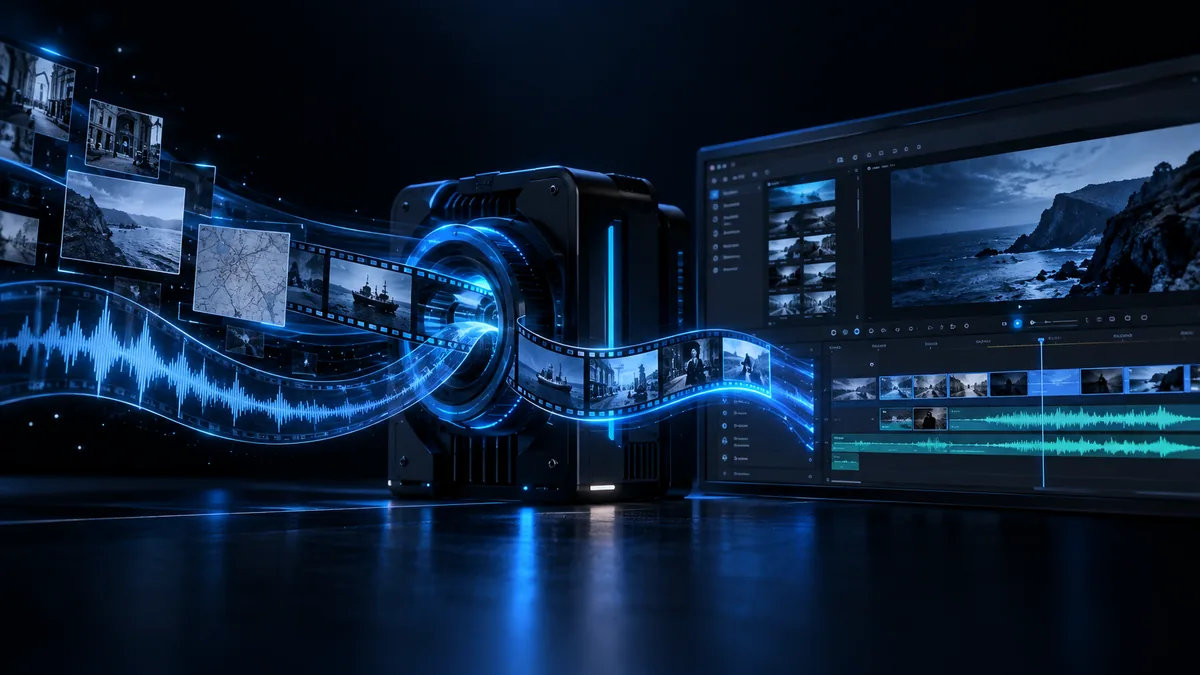
The OttoMatic Engine is an AI-assisted production system designed to turn approved scripts, narration, images, video and graphics into polished, editable video projects with far less manual assembly.
The goal is simple:
make good video faster.
Not by handing the entire creative process to a black box, but by letting software handle the repetitive mechanical work while a human remains firmly in charge of taste, pacing and final judgment.
From Script to Timeline
Traditional video production involves a surprising amount of invisible labor.
Transcripts have to be timed. Images have to be located and placed. B-roll has to be matched to narration. Graphics need to appear at the right moment. Timelines need to be assembled, checked and reorganized before the creative edit can really begin.
OttoMatic is being built to compress that process.
The system can analyze narration, align it with an approved script, catalog available media and use AI-assisted editorial reasoning to determine which visual assets best support each section of the story.
Those decisions are converted into a structured production plan and then assembled through deterministic code into an editable timeline for Final Cut Pro.
AI Where It Helps. Rules Where They Matter.
OttoMatic separates creative interpretation from technical execution.
AI can examine context, narrative meaning and visual relevance.
Code handles timing, media references, track placement, validation and timeline construction.
That distinction matters.
The system is not asking a language model to improvise an editing file and hope Final Cut appreciates the gesture. Editorial decisions pass through a defined machine-readable production contract before the timeline is generated and validated.
The result is a pipeline intended to combine the flexibility of modern AI with the predictability of conventional production software.
Or, in suitably expensive-sounding terminology:
semantic editorial orchestration with deterministic timeline synthesis.
There. Marketing department satisfied.
Built for Rapid Production
The initial target is short-form professional production for YouTube and commercial work, particularly projects built around narration, archival images, graphics, maps, historical material and supporting video.
The current production goal includes multiple videos per week across several channels, with typical programs running roughly five to nine minutes.
As the system develops, OttoMatic is expected to assist with tasks such as:
- automatic narration transcription and timing;
- script-to-audio semantic alignment;
- intelligent image and B-roll selection;
- automated rough-cut assembly;
- reusable motion graphics and lower thirds;
- maps, titles, callouts and overlays;
- automated camera movement on still images;
- music and sound-effect cue placement;
- asset validation and production checks;
- batch processing across multiple projects.
The object is not to remove the editor.
It is to remove the editor from jobs a computer should have been doing already.
A Connected Production Pipeline
OttoMatic is being designed around a modular production stack rather than a single monolithic application.
Audio can be prepared and mastered in Reaper. Graphics and restored imagery can come through the Affinity suite. Reusable visual systems can be built in Apple Motion. Python services handle alignment, media indexing, AI orchestration, validation and timeline generation. Final Cut Pro remains the primary environment for creative finishing, color, timing and delivery.
That modular approach also allows individual components to improve without requiring the entire system to be rebuilt around whatever technology happens to be fashionable this month.
Human Finishing Included
Automation can get a production remarkably far.
It still does not know when a shot feels half a second too long.
That is where the human comes back in.
OttoMatic is intended to produce a strong, organized and editable starting point, leaving the final decisions about rhythm, emphasis, comedy, tension, color and storytelling to the editor.
The machine handles the scaffolding.
The human decides whether the building is worth looking at.
In Development
OttoMatic Engine is currently under active development.
The final workflow, interface and feature set will continue to evolve as the production system moves from automated still-image rough cuts toward video selection, reusable graphics, voice tools, automated motion and larger-scale production workflows.
Want to know when it's ready? Email us at info@nightotter.com.